Let’s be honest. You started your business because you are good at what you do, not because you wanted to become a Google expert.
But here is the problem. Your customers are on Google right now, searching for exactly what you sell. And if your business is not showing up in those results, they will find someone else. Probably one of your competitors.
That is where SEO comes in. And no, it is not complicated. Not when someone explains it properly.
In this guide, we are going to walk you through everything you need to know about SEO for small businesses in the UK. What it is, how it works, what it costs, and what steps you can take today to start getting found online with clear, honest advice from a team that has helped UK small businesses do exactly this.
1. What Is SEO? (The Simple Version)
SEO stands for Search Engine Optimization. In simple words, SEO is the process of improving your website’s visibility on search engines like Google and Bing.
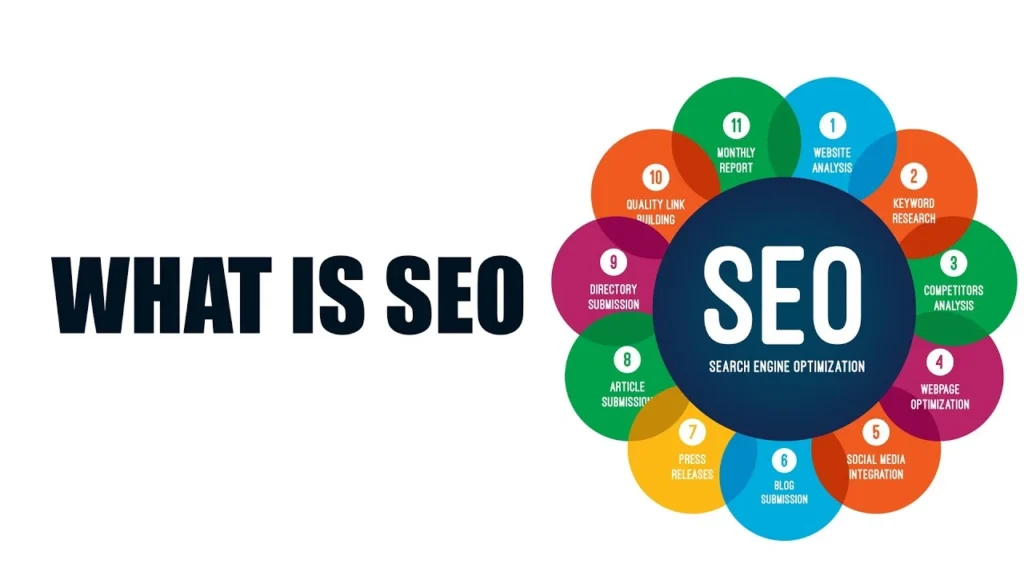
But what does that actually mean?
Think about Google like a massive library. Millions of books (websites) are sitting on the shelves. When you type something into Google, Google sends out tiny digital robots, called crawlers, to find the most helpful, most trustworthy books about that topic. Then Google puts those books in order, from most helpful to least helpful. The top result gets seen first. The bottom results barely get seen at all.
SEO is the work you do to make your website one of the helpful books that Google picks first. Let’s make it simpler.
Imagine you run a bakery in Aldershot. When someone types ‘best bakery near me’ or ‘fresh bread Aldershot’ into Google, do you show up? If not, your competitor down the road probably does. And they are getting the customer instead of you.
SEO fixes that. It helps Google understand that your bakery exists, where it is, and that it is the best option for people nearby.
Remember: SEO is not about tricking Google. It is about making your website genuinely useful and easy to understand, for both Google and the real people visiting your site.
2. Why Does SEO Matter for Small Businesses in the UK?
You might be thinking,’ I already have a website. Is that not enough?’ Unfortunately, just having a website is like printing flyers and keeping them locked in a drawer. People cannot find what they cannot see.
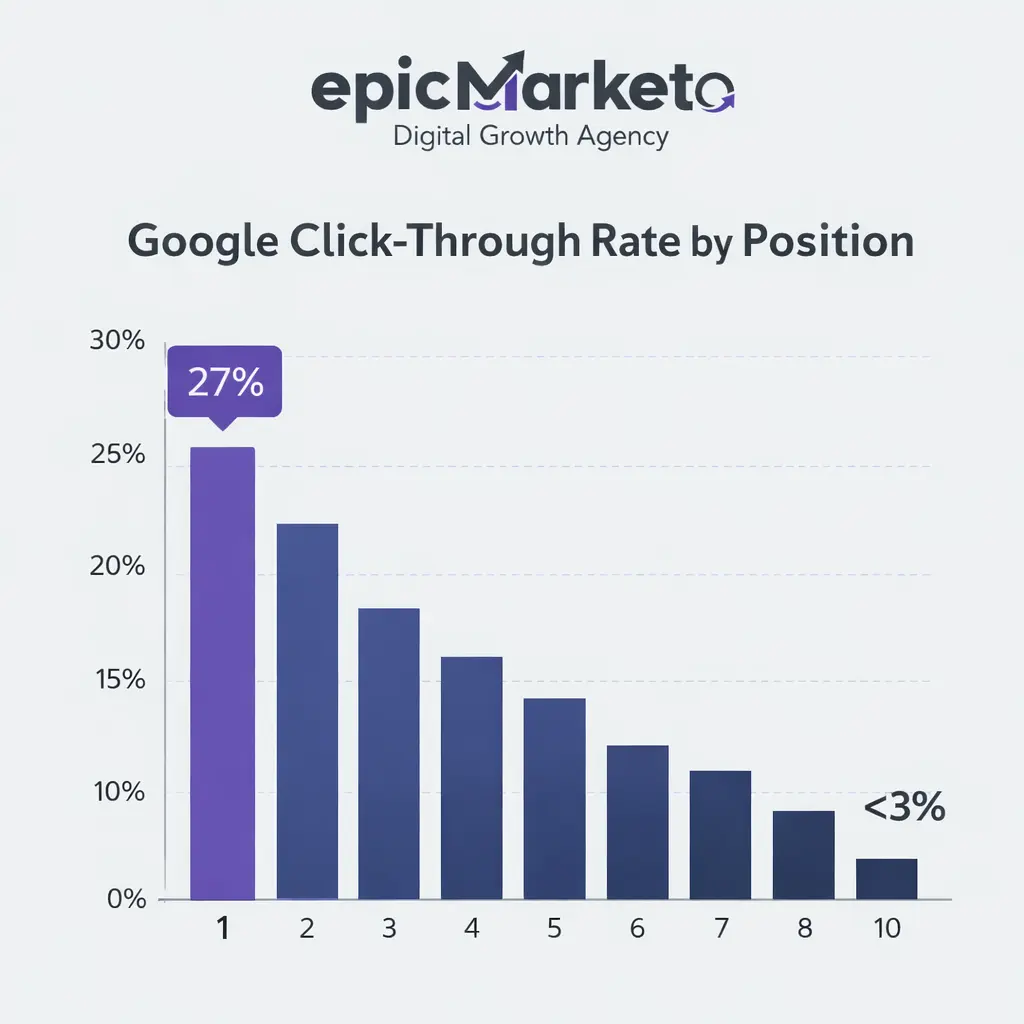
Here is the reality of how UK customers find local businesses today:
- 93% of UK consumers search online before making a purchase decision
- 76% of people who search for something nearby on their phone visit a business within 24 hours
- Only 0.63% of Google searchers click past the first page of results
- Businesses that rank on page one of Google receive over 90% of all search traffic
That last point is the important one. Page two of Google is basically invisible. If your website is sitting there, almost nobody will ever find it.
The Difference Between SEO and Paid Ads
Paid ads, like Google Ads, put you at the top of Google, but you pay every time someone clicks. The moment you stop paying, you disappear.
SEO is different. It takes longer to build, but once your rankings are there, they keep sending you traffic without you paying for every click. Think of paid ads like renting a shop and SEO like owning one. Renting gets you in quickly. Owning builds real value over time.
3. Types of SEO
SEO is not just one thing. It has different parts, and each part does a different job. Here are the four main types.
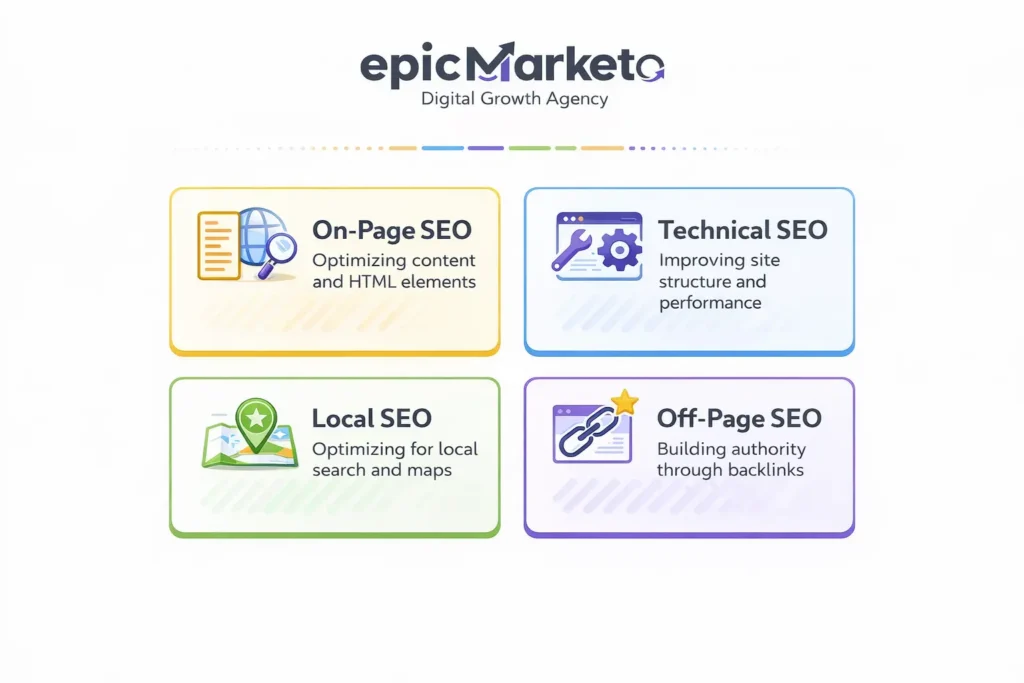
On-Page SEO
This is everything you do on your actual website pages. It includes the words you write, the headings you use, the images you add, and how you structure each page. When you write a page about your service and include the words people actually search for, that is on-page SEO. It includes:
- Using the right keywords in your headings and paragraphs
- Writing clear, helpful content that answers real questions
- Adding proper titles and descriptions to every page
- Making sure your images have descriptions that Google can read
- Learn everything in Backlinko’s On-Page SEO Guide.
Technical SEO
This is about how well your website is built behind the scenes. You do not need to understand the code, but you do need to know it matters. If your website loads slowly, does not work properly on mobile phones, or has broken links, Google notices and pushes your site lower in results. Technical SEO mainly focuses on:
- Website loading speed (especially on mobile)
- If the website works properly on all screen sizes
- No broken links or error pages
- Secure website (HTTPS, not HTTP)
Local SEO
If you run a local business, a shop, a restaurant, a plumbing business, or a solicitor’s practice, then local SEO is the most important type for you. It is what makes you show up when someone nearby searches for your service. If you have done proper local SEO for your business, there are high chances of getting leads through local search. Local SEO experts basically work on:
- Setting up and optimising your Google Business Profile
- Getting your business listed correctly in online directories
- Collecting genuine customer reviews on Google
- Making sure your address and phone number are the same everywhere online
Good news for local businesses
Local SEO, getting found in Google Maps and local searches, tends to work faster than national SEO. If you optimize your Google Business Profile and build local reviews, you can start seeing results within 4–8 weeks in many cases. We have helped businesses in Hampshire start appearing in local Map results within 6 weeks.
Off-Page SEO
This is about what happens on other websites, not your own. The main thing here is getting other reputable websites to link to yours. Google sees these links as votes of confidence. The more good websites that link to you, the more trustworthy Google thinks you are. It involves:
- Getting links from other websites and directories
- Being mentioned in the local press or online publications
- Building your reputation as a trusted business online
4. How Does Google Decide Who Ranks Number One?
This is the big question everyone wants answered. And while Google keeps its exact recipe a secret (it has over 200 ranking factors), we know the most important ones from years of research and real-world testing.
Here is how to think about it. Google wants to give its users the best possible answer to their search. So it asks these questions about every webpage:
1. Is this page relevant? Does it actually answer what the person searched for?
2. Is this page trustworthy? Does a credible, real business or expert stand behind it?
3. Is this page a good experience? Does it load quickly, look good on mobile, and work properly?
Your job with SEO is to make sure Google can answer ‘yes’ to all three questions about your website.
The things that matter most in 2026
Some important factors really help your business to make a strong online appearance and increase sales.
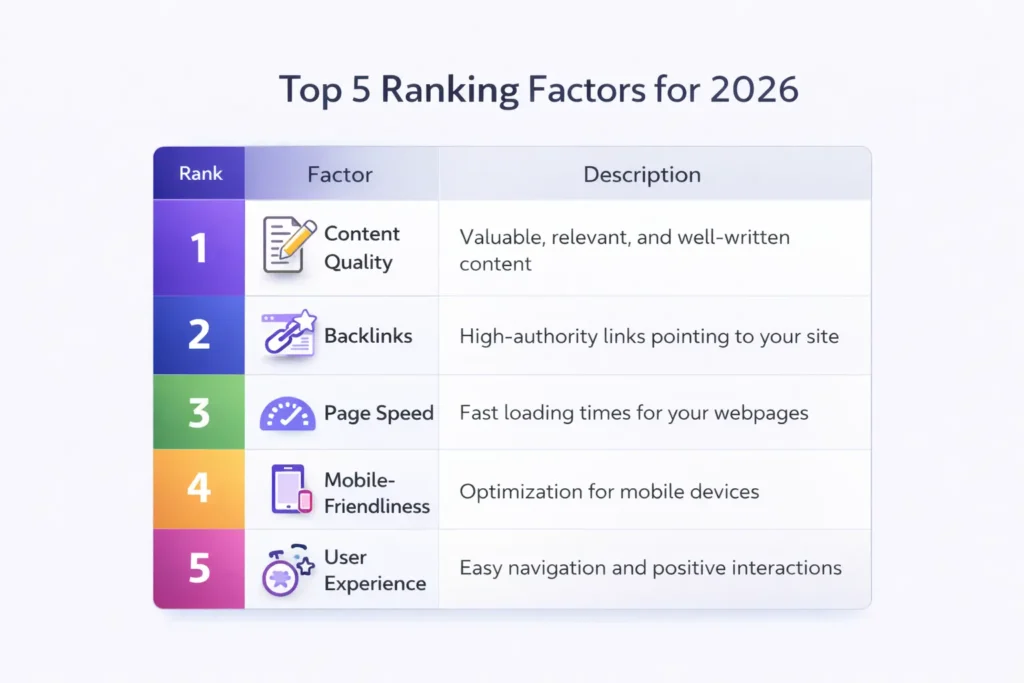
- Good, helpful content that genuinely answers what people are searching for
- A fast website that works perfectly on mobile phones
- Other trustworthy websites linking to yours
- A complete and active Google Business Profile (for local search)
- Real customer reviews on Google
- Correct, consistent business information across the web
5. How Long Does SEO Take to Work?
This is probably the most common question we get from UK small business owners. And we are going to give you an honest answer, not the answer agencies often use to avoid the question.
SEO takes time. There is no way around that. If anyone tells you they can get you to the top of Google in a week, they are either lying or using risky methods that could get your site penalized later.
Here is a realistic timeline for UK small businesses:
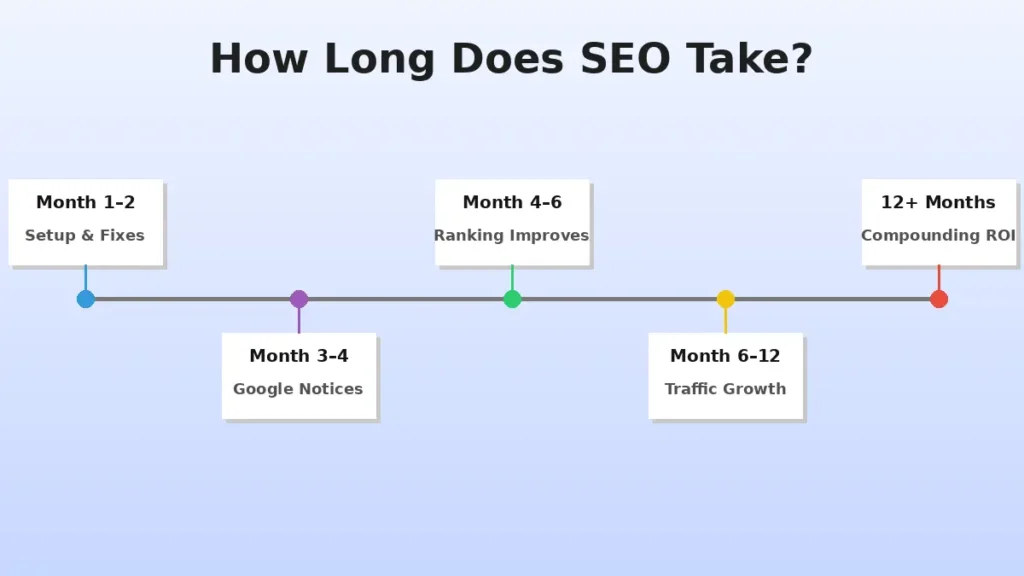
- Months 1–2: Your website gets technically fixed, content is improved, and Google Business Profile is set up properly. You will not see ranking changes yet; this is the foundation work.
- Months 3–4: Google starts crawling and understanding your improved site. You may see small movements in rankings. Some pages might start appearing in search.
- Months 4–6: Noticeable ranking improvements for less competitive search terms. Traffic starts growing. Local SEO results can appear faster, sometimes within 60–90 days.
- Months 6–12: Stronger, more consistent rankings. Real, measurable increases in website visitors and inquiries. This is where SEO starts paying for itself.
- 12 months+: This is where SEO compounds. Older, well-optimized content ranks stronger. New content ranks faster because Google already trusts your site.
6. How Much Does SEO Cost for Small Businesses in the UK?
Let’s talk about money, because this is where most agency websites are vague and unhelpful. We believe in being straightforward about it.
SEO in the UK for small businesses typically costs between £300 and £2,000+ per month, depending on the level of work, your industry, and how competitive your local market is.
What affects the cost?
- How competitive is your industry
- Whether you need local, national, or e-commerce SEO
- The level of ongoing work required each month
Is SEO worth the cost for small businesses?
The honest answer: yes, but only if it is done properly and given enough time to work.
The businesses that say ‘SEO did not work for us’ almost always either stopped too soon, hired a cheap service that did bad work, or had unrealistic expectations about the timeline.
7. How to Start SEO for Your Small Business: A Step-by-Step Guide
Right. Enough theory. Here is exactly what you should do to improve the ranking of your local business.
Step 1: Set Up Google Business Profile
If you serve customers in a specific area, this is your single most important SEO action. It is completely free, and it is what makes you show up on Google Maps.
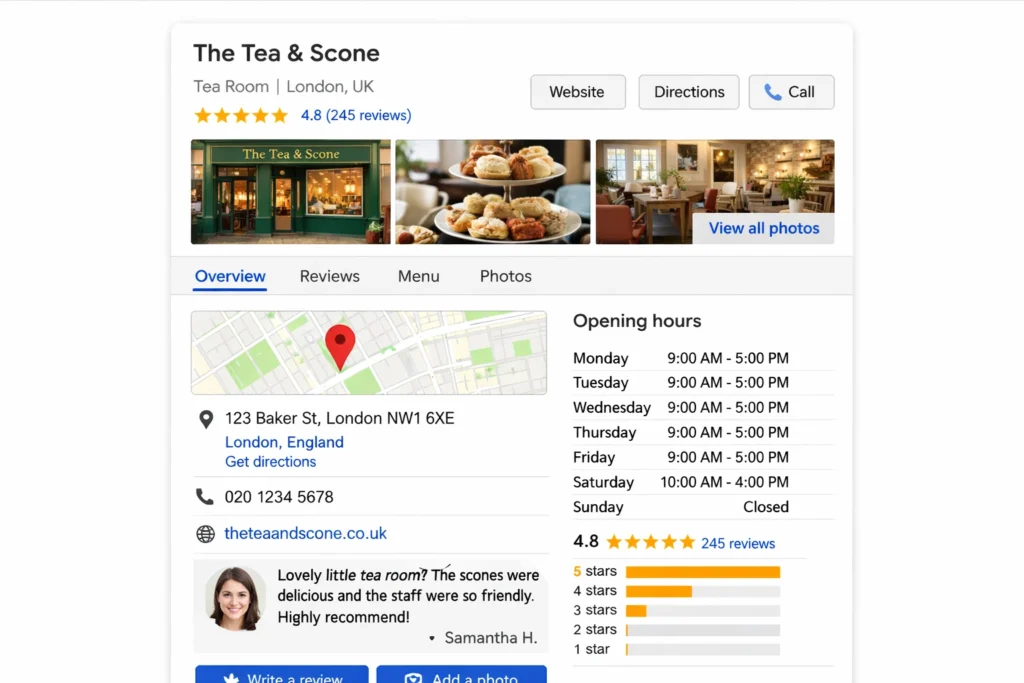
1. Go to business.google.com and sign in with a Google account
2. Click ‘Add your business.’
3. Enter your business name, category, address, phone number, and website
4. Verify your business. Google usually sends a postcard or lets you verify by phone
5. Add photos, your opening hours, and a description of what you do
Ask your customers to leave you Google reviews; every review helps in ranking
Step 2: Make Sure Your Website Loads Fast on Mobile
Over 60% of UK searches happen on mobile phones. If your website is slow or hard to use on a phone, Google will rank it lower, even if your content is great.
Test your site right now: go to pagespeed.web.dev, type in your web address, and click ‘Analyse’. If your mobile score is below 75, you have work to do. The most common fixes are: compressing your images, using a caching plugin, and checking your website builder’s performance settings.
Step 3: Write Content That Answers Real Questions
Every page on your website should answer a specific question your customer is asking. Not ‘here is who we are’, but ‘here is how we solve your problem’.
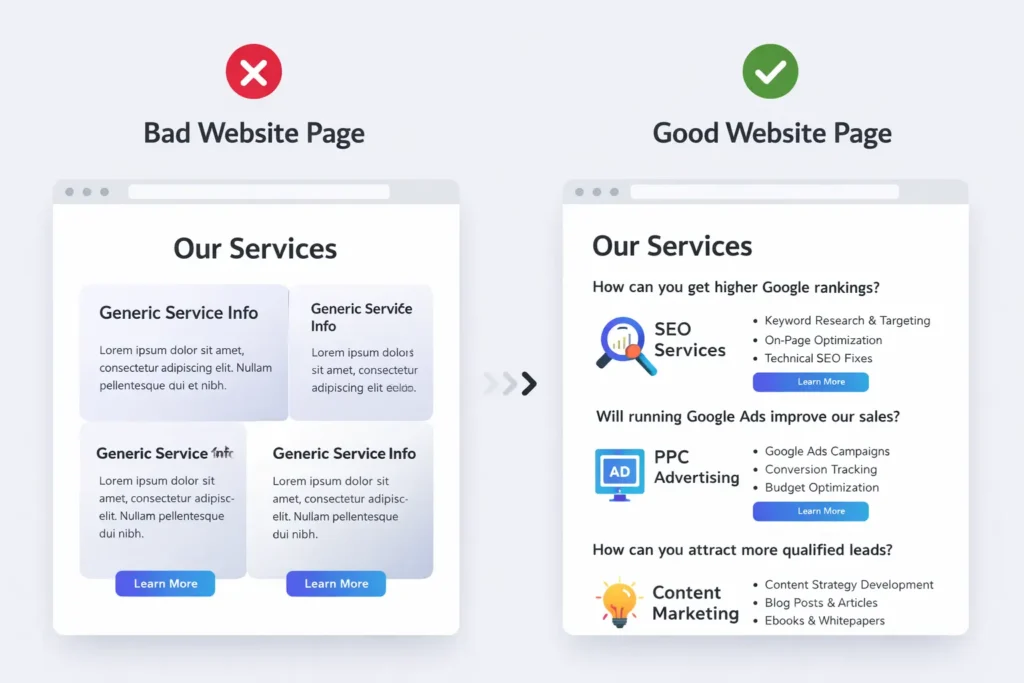
Think about the questions you get asked all the time by customers. ‘How much does it cost?’ ‘How long does it take?’ ‘What areas do you cover?’ Each of these is a blog post or a page on your website. Write honest, helpful answers, and Google will reward you.
- Write four new pieces of helpful content per month.
- Use the words your customers actually use, not industry jargon
- Answer the full question and do not stop halfway through
- Always end with a clear next step for the reader
Step 4: Get Listed in UK Business Directories
Your business name, address, and phone number should appear consistently across the internet. This tells Google your business is real and trustworthy. Start with these free directories:
- Google Business Profile (most important)
- Yell.com
- Bing Places
- Apple Maps
- Thomson Local
- Trustpilot (for collecting verified reviews)
- Your local Chamber of Commerce website
Step 5: Build Local Links
Ask local businesses, suppliers, and organizations you work with if they would be willing to link to your website. Sponsoring a local event, getting featured in a local newspaper, or joining your local business association can all earn you backlinks that boost your local search rankings.
Quick wins you can do this week
- Set up or complete your Google Business Profile
- Ask your 3 most loyal customers to leave you a Google review
- Run a free speed test at pagespeed.web.dev
- List your business on Yell.com and Bing Places
- Check every page on your site has a proper title and description in Yoast SEO
8. SEO Mistakes UK Small Businesses Keep Making
After working with many of the UK’s small businesses, these are the mistakes we see most often. Avoid them, and you will be ahead of most of your competitors already.
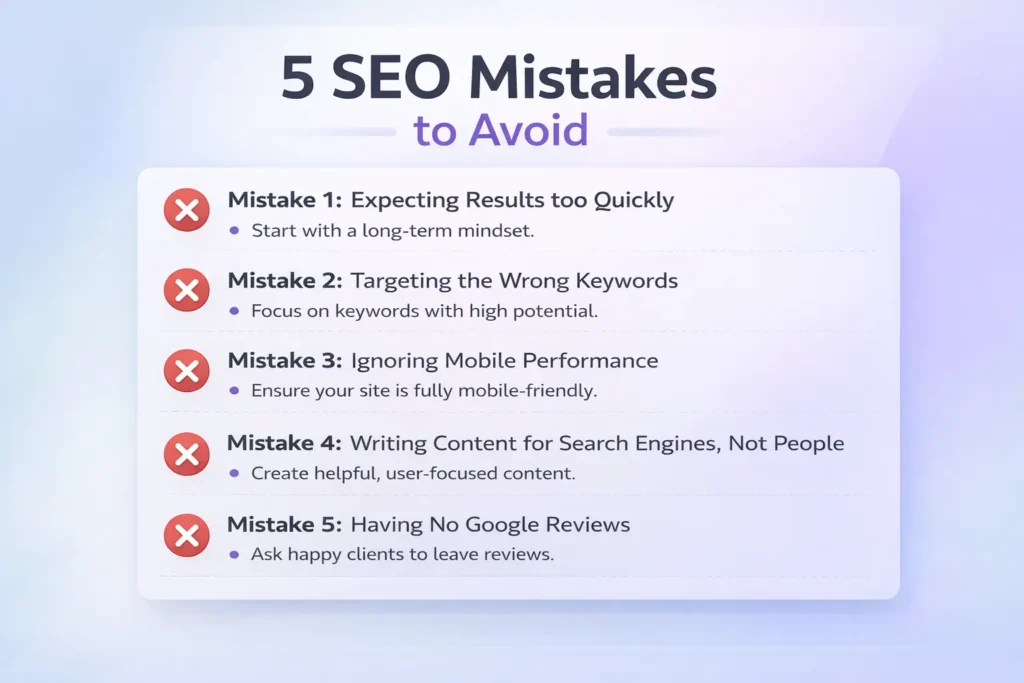
Mistake 1: Expecting results too quickly and giving up
SEO is a long-term investment. Stopping after two months because you have not seen results is like planting seeds, waiting a week, and pulling them all up. Give it at least six months before judging whether it is working.
Mistake 2: Targeting the wrong keywords
A lot of small businesses target the most popular, most competitive keywords, and wonder why they never rank. ‘Digital marketing agency’ is searched by hundreds of thousands of people, but is dominated by massive companies. ‘Digital marketing agency for small businesses in Hampshire‘ is searched far less, but is actually winnable for a local agency. Go specific. Win small keywords first.
Mistake 3: Ignoring mobile performance
If your site is slow or broken on mobile, nothing else you do for SEO will work properly. Google ranks the mobile version of your site first. Fix mobile performance before anything else.
Mistake 4: Writing content for search engines, not people
Stuffing your pages with keywords and repeating the same phrase 20 times used to work in 2010. In 2026, Google penalized it. Write for real people first. If a human would find it helpful, Google will too.
Mistake 5: Having no Google reviews
Reviews are one of the most powerful signals for local SEO. A business with 50 genuine Google reviews will almost always rank above a business with none, even if the other business has a better website. Ask every happy customer for a review and make it easy by sending them the direct link.
9. Do You Need to Hire an SEO Agency or Can You Do It Yourself?
This is a fair question, and we are going to answer it honestly, even though we are an SEO agency.
The truth is: you can learn and do basic SEO yourself. Google’s Business Profile setup, writing helpful content, and getting listed in directories are all things any business owner can do with a bit of time and effort. We even wrote a guide on how to learn SEO for free.
However, there are situations where hiring a proper SEO agency makes much more sense:
- You are in a competitive industry where ranking requires serious, consistent work
- You have a website with technical problems that are holding back your rankings
- Want to grow faster than DIY SEO allows
- You do not have the time to learn and implement SEO properly yourself
- You have tried SEO before, and it did not work, and you want to understand why
What to look for in a UK SEO agency
Not all agencies are equal. Here is what to look for, and what to avoid:
- They show you real results from real clients, not just vague claims
- They explain everything in plain English
- They are honest about timelines
- They do not lock you into long, inflexible contracts
- They have genuine reviews from real UK businesses
10. SEO and Content Marketing: Why They Go Together
You cannot talk about SEO without talking about content. Google’s job is to find the best answer to every question. If your website has genuinely helpful, well-written content, you give Google something worth ranking.
For small businesses, the most effective approach is to write content that answers the exact questions your customers are asking before they buy. This type of content builds trust, attracts organic search traffic, and gently moves readers towards becoming customers.
What types of content work best for UK small businesses?
If you want to rank your content on Google, check if your website has this structure or not.
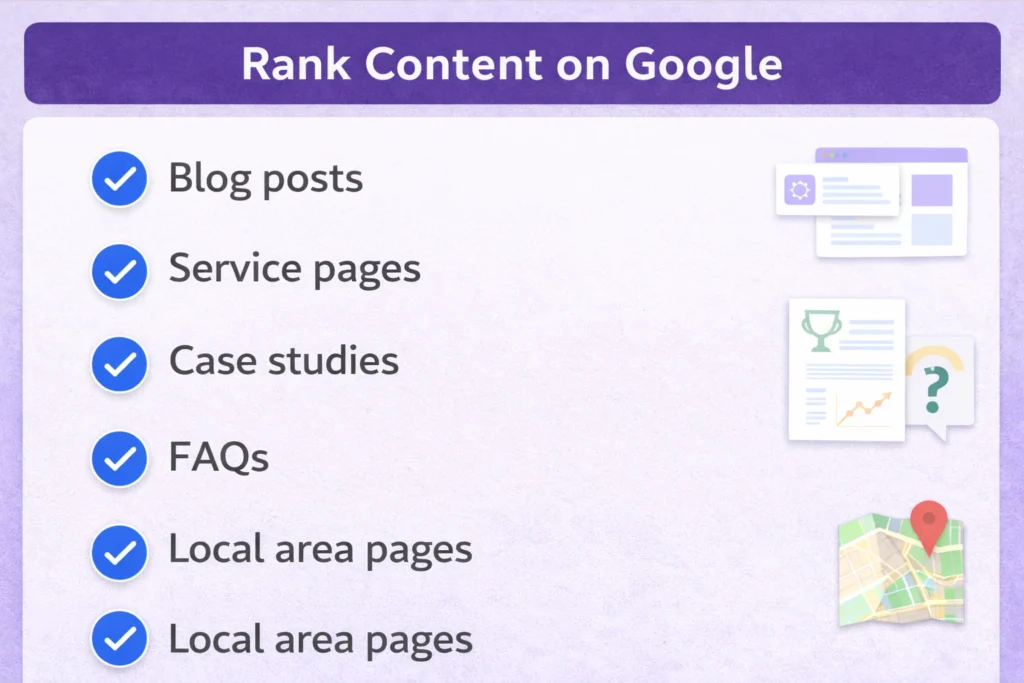
- Blog posts that answer common customer questions (e.g., ‘How much does X cost in the UK?’)
- Service pages that clearly explain what you do, who you help, and where you are based
- Case studies that show real results you have delivered for real customers
- FAQs that address objections and common concerns
- Local area pages that target specific towns, cities, or regions you serve
11. SEO for E-commerce Small Businesses
If you run an online shop and you need ecommerce SEO services, then there are some extra things SEO needs to cover for you.
- Every product page needs its own unique, helpful description, not the manufacturer’s generic copy
- Category pages need proper content explaining what the category contains and who it is for
- You need to make it easy for Google to crawl and index thousands of product pages
- Customer reviews on product pages are extremely powerful for both SEO and conversions
- Structured data (schema markup) helps Google show your products, prices, and ratings directly in search results
Frequently Asked Questions
How long does SEO take to work for a UK small business?
Most UK small businesses start seeing noticeable results between 3 and 6 months after starting SEO. Local SEO, appearing in Google Maps and local search results, can show results faster, sometimes within 4–8 weeks. National or competitive keywords typically take 6–12 months of consistent work.
How much does SEO cost for small businesses in the UK?
SEO for UK small businesses typically costs between £300 and £2,000 per month, depending on how competitive your industry is, what level of work is needed, and whether you need local or national SEO. Some agencies, like epicMarketo, offer performance-based pricing for e-commerce businesses.
Can I do SEO myself as a small business owner?
Yes. The basics of SEO are learnable by anyone. Setting up Google Business Profile, improving your website content, and getting listed in directories are all things you can do yourself. However, technical SEO, link building, and competitive keyword strategy often benefit from professional help.
What is the most important SEO action for a local UK business?
Setting up and fully completing your Google Business Profile is the single most important thing you can do for local SEO. It is free, it puts you on Google Maps, and it directly affects whether you appear in local search results. After that, collecting genuine customer reviews is the next highest-impact action.
What is the difference between organic SEO and paid advertising?
Organic SEO means earning your position in Google search results through good content, website quality, and trusted links, without paying for clicks. Paid advertising (like Google Ads) puts you at the top of results immediately, but you pay each time someone clicks. SEO takes longer but provides sustainable, free traffic over time.
Why is my website not showing up on Google?
There are several common reasons: your site may not be indexed by Google yet, your content may not match what people are searching for, your site may have technical issues, or your competitors simply have stronger SEO. A free SEO audit can identify the specific reason and show you exactly what needs to be fixed. For small business owners, we are offering a free SEO audit to highlight key areas that need improvement for better ranking.
Is SEO worth it for a small business with a tight budget?
Yes, but you need to be strategic. Start with the free actions: Google Business Profile, collecting reviews, and improving your existing content. When you are ready to invest, even a modest monthly SEO budget focused on local search can deliver a strong return if the work is done properly.
How does epicMarketo help small businesses with SEO?
epicMarketo is a UK-based digital marketing agency that specialises in SEO for small businesses and e-commerce stores. We offer local SEO, organic SEO, and e-commerce SEO, with transparent reporting and no long-term contract requirements. We are based in Aldershot, Hampshire, and work with clients across the UK.
Final Thoughts
If you have made it this far, congratulations. You now know more about SEO than most UK small business owners. And that already puts you ahead.
Here is the most important thing to remember: SEO is not magic. It is not overnight. But it is one of the most powerful, most cost-effective ways to grow a small business over the long term. Every page you improve, every review you collect, every piece of helpful content you publish, it builds up. Slowly at first, then all at once.
You do not have to do everything at once. Start with your Google Business Profile. Get a few reviews. Write one helpful blog post. Those small steps compound into real results.
And if you want help, the kind of help that is honest, plain-spoken, and actually focused on your results, that is what epicMarketo does. Get Your Free SEO Review from epicMarketo.