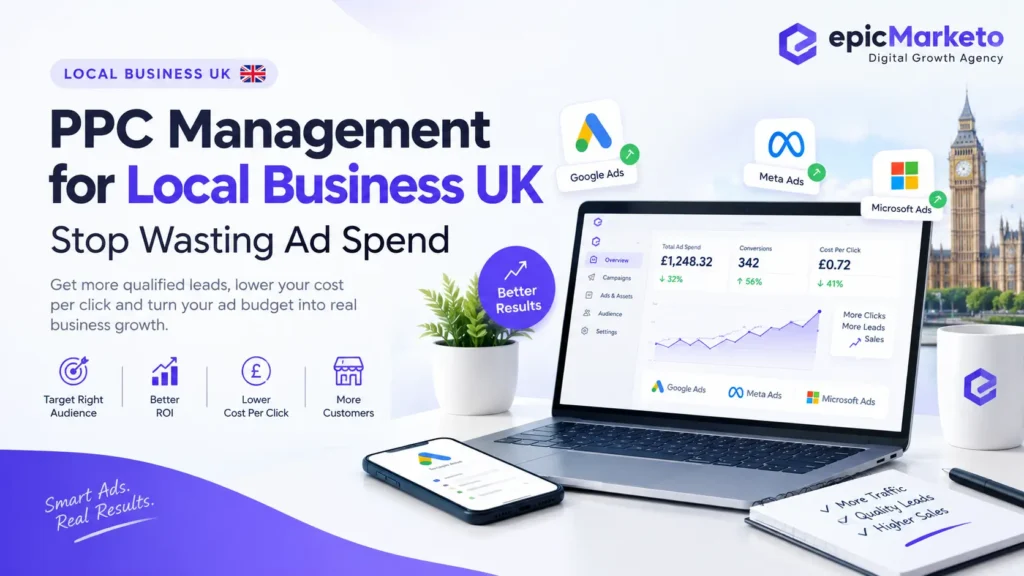
Every local business owner in the UK has a story about PPC, and it’s usually one of two stories. Either “we tried Google Ads once and it just burned through the budget with nothing to show for it,” or “we found someone who actually knows what they’re doing, and now it’s the first thing we’d cut last, not first.”
The frustrating truth is that both experiences can come from the exact same platform, the exact same budget, even the exact same industry. The difference almost never comes down to luck. It comes down to whether the campaign was actually managed, or just switched on and left to run.
Google holds over 90% of the search market in the UK, which means that gap between “burned budget” and “first thing that pays for itself” usually decides whether a local business shows up right when someone nearby is actively searching for what it sells, or quietly disappears below three competitors who bothered to get it right.
Why PPC Works Differently for Local Businesses
Generic PPC advice mostly assumes national or global reach, which isn’t how a local plumber, salon, or clinic actually needs to compete. Local PPC management has its own set of rules:
- Location targeting matters more than almost anything else. A radius set too wide wastes budget on clicks from people who will never actually visit. Set too narrow, and genuine nearby customers get missed.
- Call tracking often matters more than form fills. Many local searches end in a phone call, not a web form — a campaign not tracking calls properly is often invisible to its own real results.
- “Near me” and location-based searches behave differently. These searches usually carry higher intent and often convert faster than broader keyword searches, but they need to be built into the campaign structure deliberately, not as an afterthought.
- Google Business Profile and PPC work together. Local ad performance is often stronger when it’s paired with an active, well-reviewed Google Business listing the two reinforce each other rather than operating in isolation.
A generic PPC setup that ignores all of this can spend the same budget as a properly localised one and produce a fraction of the results.
The Real Reason Most “Failed” PPC Campaigns Actually Fail
It’s rarely the platform. It’s almost always one of a handful of specific, fixable mistakes:
Broad match keywords with no negatives. Without negative keywords filtering out irrelevant searches, budget quietly leaks toward clicks that were never going to convert someone searching “how to fix a boiler myself” clicking an ad for boiler repair services, for instance.
Sending traffic to a homepage instead of a dedicated landing page. A generic homepage forces the visitor to hunt for what the ad promised. A landing page built around the exact offer in the ad converts dramatically better.
No conversion tracking set up at all. Without tracking calls, form fills, or bookings, there’s no way to actually know which keywords or ads are working decisions end up based on guesswork instead of data.
Set-and-forget management. A campaign left untouched after launch drifts. Bids need adjusting, underperforming ads need replacing, and new negative keywords need adding as real search data comes in. PPC is not a one-time setup; it’s ongoing work.
What Proper PPC Management Actually Involves
A genuine, professionally managed PPC service for a local business should include:
- A discovery conversation — understanding the business, margins, and what an actual “good lead” looks like, not just clicks
- Keyword research and campaign structure built around service and location, so ads stay tightly relevant
- Compelling ad copy and proper conversion tracking, set up before the campaign ever goes live
- Ongoing monitoring and optimisation — adjusting bids, reviewing search terms, testing new ads, adding negatives
- Clear reporting in plain language spend, clicks, conversions, and cost per lead, not just a wall of numbers
If a provider only offers the first two steps and calls it done, that’s account setup, not management and it’s exactly the kind of PPC that quietly burns budget after the first few weeks.
What It Costs to Do This Properly in the UK
Costs typically split into two parts: the ad spend itself (paid directly to Google or Bing) and the management fee (paid to whoever runs the campaign). For a local UK business, a realistic starting ad budget is often £300–£800 a month, with management fees typically running £200–£500 a month for a single, well-run campaign scaling up as budgets and complexity grow.
It’s worth resisting the instinct to judge PPC purely by the management fee. A cheap fee attached to a poorly structured campaign can waste far more in ad spend than a slightly higher fee attached to a properly optimised one.
Google Ads or Bing Ads, or Both?
Google dominates UK search, so it’s usually the natural starting point. But Bing Ads often comes with lower competition and cheaper clicks, particularly among certain UK audiences using Windows devices by default. For many local businesses, running both even with Bing taking a smaller slice of the budget brings in extra leads at a lower blended cost per lead than relying on Google alone.
How Fast Results Actually Show Up
Traffic and early click patterns typically appear within days of a campaign going live. But genuinely reliable data a real, stable cost per lead you can trust usually takes a few weeks of live performance and active optimisation to settle. Judging a campaign after three days is judging it before it’s had a chance to learn anything.
The Difference Was Never the Budget
Two local businesses can spend exactly the same amount on PPC and end up with completely different results, and it’s rarely because one got lucky. It’s because one campaign was built around location, tracked properly, and adjusted every week and the other was switched on and left alone. Fixing that gap is almost always cheaper than the budget already being quietly wasted without it.