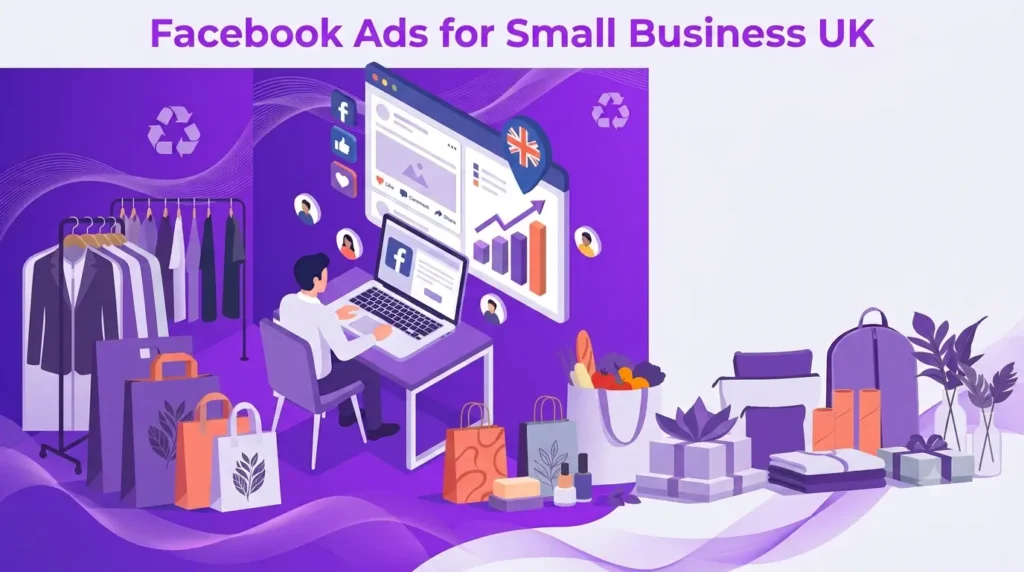
Facebook ads for small business UK owners can be one of the cheapest, fastest ways to get in front of local customers or a slow leak in the bank account that nobody notices until the quarterly numbers come in. The difference almost never comes down to budget. It comes down to whether the person running the ads actually understands what they’re doing, or whether they’re guessing and hoping the algorithm sorts it out.
Why This Actually Matters (Beyond the Obvious)
Here’s the thing nobody tells you when you’re setting up your first campaign: Facebook isn’t really “Facebook ads” any more. It’s Meta ads, running across Facebook, Instagram, Messenger, and the Audience Network, all pulling from the same budget and the same targeting engine. Get that engine pointed at the wrong audience and you can burn through £300 in a fortnight without a single enquiry.
For a small business, that’s not a rounding error. That’s a week of stock, or half a month’s rent on a unit, or the invoice you were hoping to pay off early. Bigger companies can absorb a failed campaign and shrug it off as “testing.” A sole trader running a garden landscaping business in Surrey cannot.
There’s also a trust problem brewing. UK consumers have gotten sharper about ads they scroll past generic stock-photo promotions without a flicker of interest. A poorly targeted, badly written ad doesn’t just fail to convert; it can actively damage how people see your brand, because it reads as lazy or desperate. Small business Facebook advertising UK-wide has a credibility gap to close before it even gets to the sales pitch.
And then there’s the local angle, which most guides skip entirely. If you’re a business that depends on people within a 10-mile radius a salon, a takeaway, a driving school geo-targeted Facebook ads aren’t optional extras. They’re the entire point. Run a UK-wide campaign for a hairdresser in Preston and you’ve essentially set fire to two-thirds of your budget before lunch.
The Mistakes I See Over and Over
Boosting posts instead of building actual campaigns. This is the big one. Boosting is Facebook’s version of a vending machine quick, easy, and designed to get you spending with minimal thought. But boosted posts skip the proper campaign structure, meaning you lose control over objective, audience refinement, and critically the ability to actually test what’s working. It feels like advertising. It rarely performs like it.
Targeting too broad, or too narrow, with nothing in between. I’ve seen local bakeries target “all of the UK, ages 18-65” because narrowing the audience felt scary, like they were shutting doors. The opposite happens the algorithm can’t find the right people in that soup, so it just spends evenly and badly. On the flip side, I’ve seen businesses narrow so aggressively (postcode-specific, single interest, tiny age band) that Facebook can’t spend the budget at all, and the campaign limps along at half pace.
No real creative testing just one ad, left running for months. Ad fatigue is real. The same creative shown to the same local audience for eight weeks straight starts costing more per click every single week, because Facebook down-ranks stale content. Most small businesses set an ad live and forget about it, then wonder why the cost-per-click doubled by month two.
Sending traffic to a Facebook page instead of a proper landing page. This one’s almost forgivable, since it’s the path of least resistance. But a Facebook page isn’t built to convert it’s built to keep people on Facebook. If there’s no clear next step (book now, claim offer, call this number), you’re paying for clicks that go nowhere useful.
Ignoring the pixel entirely. Without the Meta Pixel installed and firing correctly on your website, you’re advertising blind. You can’t retarget the people who visited but didn’t buy. You can’t tell Facebook what a “good” customer looks like. It’s the difference between throwing darts with the lights on or off.
What It Actually Costs (No Sugarcoating)
Let’s talk real numbers, because vague pricing helps nobody.
For a local UK small business, a workable starting ad spend sits somewhere between £5–£15 a day, or roughly £150–£450 a month, run consistently rather than in short bursts. Anything much lower than that and Facebook’s algorithm doesn’t get enough data to optimise properly — you’re essentially paying tuition fees to the platform without graduating.
Cost-per-click in the UK varies wildly by industry. Home services and trades often sit around £0.50–£1.50 per click. Retail and e-commerce tends to run £0.80–£2. Anything in finance, legal, or insurance can climb past £3–£5 per click, because the competition for those audiences is brutal.
Cost-per-lead is the number that actually matters for most small businesses, and it’s the one people forget to track. A well-run local campaign should be landing leads somewhere in the £8–£30 range, depending on the industry and how competitive the local market is. If you’re paying £70+ per lead for a local trades business, something in the targeting or creative is broken.
If you’re outsourcing this to an agency or freelancer, expect management fees somewhere between £300–£800 a month for a small business account, on top of ad spend — sometimes structured as a flat fee, sometimes as a percentage of spend. Anyone quoting £100 a month “including everything” is either brand new or not actually managing the account properly. There isn’t enough time in that fee to do it well.
A Practical Checklist Before You Spend Another Penny
Before your next campaign goes live, run through this:
- Is the Meta Pixel installed and verified on your website? Not just installed — actually firing on the right pages.
- Does the ad send people to a dedicated landing page, not your homepage or Facebook page?
- Is there one clear objective per campaign (leads, sales, calls) rather than trying to do everything at once?
- Is your audience geographically realistic for how far your actual customers travel or ship?
- Do you have at least 2–3 ad variations running, so you can see what’s actually working rather than guessing?
- Have you set a frequency cap or a plan to refresh creative every 2–3 weeks to avoid fatigue?
- Is there a retargeting audience set up for people who visited but didn’t convert?
- Are you checking cost-per-lead weekly, not just glancing at reach and engagement?
If you can’t tick off at least six of those, the campaign isn’t ready — it’s just spending.
That café owner in Leeds, by the way, eventually did fix it. Not by spending more, but by spending the same £150 a month with an actual landing page, a proper pixel, and one clear offer instead of a vague “come try our coffee” post. Bookings for her weekend brunch slots went from occasional to consistently full within six weeks. Same budget. Completely different result.
Facebook ads aren’t magic, and they’re not a scam either — they’re a tool that rewards precision and punishes guesswork in almost equal measure. Most small businesses aren’t failing because the platform doesn’t work for them. They’re failing because nobody ever showed them how it actually works.
If you’d rather have someone who does this daily take a proper look at your account instead of guessing your way through another quarter, the team at EpicMarketo works with UK small businesses on exactly this — no jargon, no vague promises, just campaigns built to actually convert.