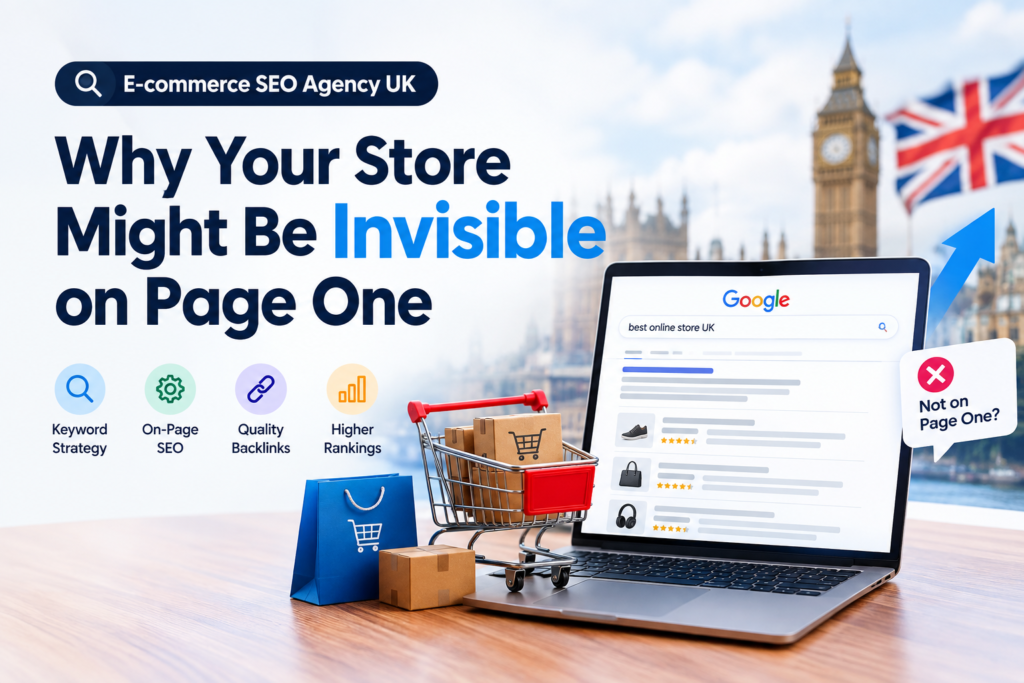
There’s a particular kind of quiet dread that sets in for online store owners around month three or four. You’ve built the shop, the products look good, the checkout works and yet when you type your own product into Google, incognito, on your phone, you’re nowhere near page one. Somewhere below you sits a bigger retailer with a worse product description, ranking effortlessly for the exact term you’d hoped would be yours.
That moment is usually when “e-commerce SEO agency UK” starts getting typed into a search bar of its own.
It’s worth saying plainly before anything else: this isn’t really about outspending anyone. The UK is the third-largest e-commerce market in the world, and while that scale creates genuine competition, it also means there’s an enormous amount of very specific, very findable search traffic that bigger stores are too generic to capture. Getting a slice of that isn’t about matching a competitor’s budget it’s about understanding exactly how e-commerce SEO differs from ordinary SEO, and why most online stores in the UK are quietly getting it wrong.
Why E-commerce SEO Isn’t the Same Job as Regular SEO
This is the part that trips up a lot of store owners who’ve tried to DIY their way through it using generic SEO advice.
Regular SEO is largely about content blog posts, service pages, building authority around topics. E-commerce SEO is a different discipline entirely. It’s about product pages that need to rank individually, category structures that either help or actively confuse Google’s understanding of your store, out-of-stock items that can quietly tank a page’s rankings if handled badly, and product schema markup that determines whether your listing shows a price and star rating directly in the search results or just a plain blue link next to competitors who do.
A store can have excellent written content and still rank poorly, simply because the technical and structural side of e-commerce SEO was never addressed. That’s usually the real gap, not effort or budget.
The Real Reason Traffic Doesn’t Always Mean Sales
Here’s a pattern worth naming honestly, because it catches a lot of stores off guard: traffic can go up while sales stay flat, and it’s rarely bad luck.
Usually it means one of two things. Either the store is ranking for keywords with browsing intent rather than buying intent people comparing, researching, window-shopping rather than ready to purchase — or the traffic is arriving on pages with a frustrating experience once it gets there: slow load times, a confusing checkout, unclear pricing. Chasing more traffic without fixing either of those first just means paying to disappoint more visitors.
Getting this right means an audit that looks past rankings and actually checks: are the keywords we’re targeting the ones people use right before they buy, not just while they’re browsing?
What a Genuine E-commerce SEO Process Looks Like
A proper e-commerce SEO engagement in the UK should cover several distinct layers, not just “writing some product descriptions”:
- A full technical audit — crawl errors, site architecture, how Google is actually seeing (or failing to see) the store right now
- Speed and technical optimisation — online shoppers are famously impatient, and a slow site loses sales long before it loses rankings
- Keyword strategy built around buying intent, not just high search volume
- Product page optimisation — titles, descriptions, and structured data that make each individual product findable and clickable
- Content and internal linking strategy that builds authority and quietly directs value toward the most profitable pages
- Clear, regular reporting tied to traffic, rankings, and critically actual revenue, not vanity metrics alone
If a quote or proposal skips straight to “we’ll write better product descriptions” without mentioning technical structure or buying intent, it’s addressing a fraction of the problem.
How Long It Actually Takes Honestly
This is worth being upfront about, because it’s the question every store owner asks and the answer often disappoints people expecting overnight results: e-commerce SEO is not fast. Early movement in rankings typically shows up within 3 to 4 months, and the traffic and revenue growth that actually changes a business tends to compound over 6 to 12 months of consistent work.
That’s not a reason to avoid it- it’s a reason to treat it as what it actually is: a long-term asset that keeps paying back long after the work slows down, unlike paid ads, where the traffic disappears the moment the budget does. The two work best together, not as alternatives ads for immediate visibility while SEO builds toward something that doesn’t switch off.
A Quick Gut-Check for UK Store Owners
Before hiring anyone, it’s worth checking your own store honestly against a few questions:
- Does your top product page load in under 3 seconds on mobile data, not office wifi?
- Do your product listings show a star rating or price directly in Google search results, or just a plain link?
- When you search your own best-selling product by name, where do you actually land page one, or nowhere close?
- Are you ranking for terms that sound like research (“best running shoes for flat feet”), or terms that sound like a decision already made (“buy Nike Pegasus 41 UK”)?
If most of those answers are uncomfortable, that’s not a failure it’s just a clear starting point.
The Store Was Never Invisible by Accident
No UK online store ends up buried on page three by chance. It’s almost always a specific, fixable combination of technical gaps, the wrong keyword targets, or product pages that were never properly built for search in the first place. None of that requires a bigger budget than the competitor sitting above you it requires actually understanding why they’re there and you’re not.