
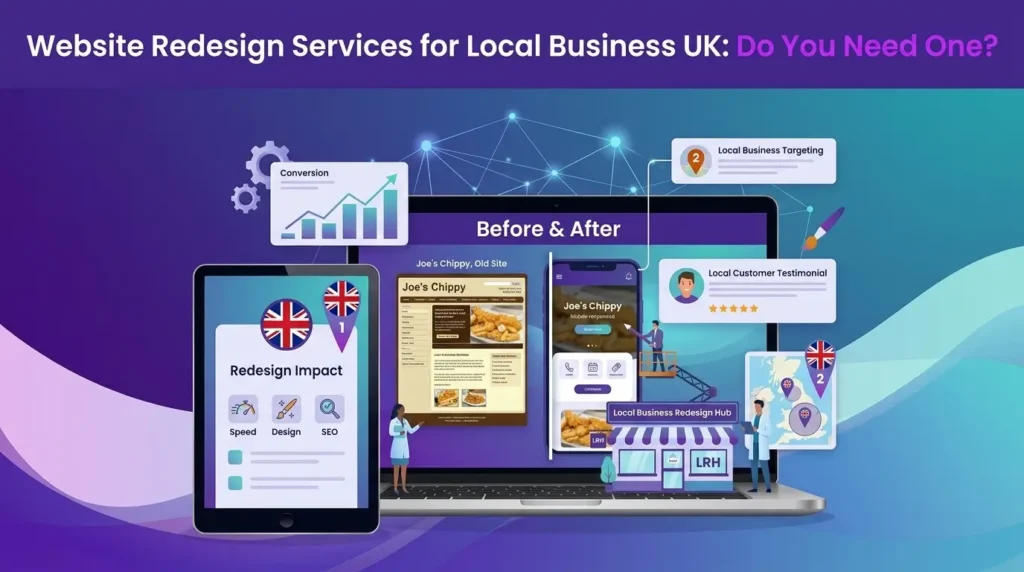
Most local business owners don’t wake up one day and decide their website needs redesigning. It’s usually smaller than that a customer mentions they couldn’t find your opening hours on their phone, or you glance at your own site next to a competitor’s and quietly wince, or you try booking your own appointment through your own form and give up halfway through out of sheer frustration.
That quiet, accumulating discomfort is usually the real signal, long before anyone says the words “we need a new website” out loud.
Here’s the thing worth untangling early: a redesign isn’t automatically the answer, and it isn’t automatically expensive or disruptive either. Sometimes a site needs a full rebuild. Sometimes it needs three specific things fixed and everything else left alone. Knowing which one you’re actually dealing with is where most local businesses in the UK waste time, money, or both.
How to Tell If You Actually Need a Redesign
There are a handful of honest signs worth checking before spending anything:
- It doesn’t work properly on a phone. Over half of UK web traffic now comes from mobile devices. If your site was built years ago and simply “shrinks” rather than being genuinely designed for mobile, that alone is often reason enough.
- It’s slow. If your homepage takes more than three seconds to load, a meaningful share of visitors are leaving before they’ve even seen it search engines penalise this too, quietly pushing slow sites down the rankings.
- You can’t update it yourself. If every small change a new opening time, a seasonal offer, a new photo means emailing someone and waiting a week, the site is costing you more in lost agility than it should.
- It doesn’t reflect what the business actually does now. A lot of local businesses grow, add services, or shift focus, while the website quietly stays frozen in whatever it was built to say three or four years ago.
- There’s no clear next step for a visitor. No obvious way to book, call, message, or enquire within a few seconds of landing just information, with no path forward.
If two or three of these sound familiar, a redesign is worth genuinely considering. If it’s really just “the colours feel a bit dated,” that’s a smaller, cheaper job a refresh, not a redesign and it’s worth knowing the difference before a quote comes in bigger than it needed to be.
Redesign vs. Refresh: The Distinction That Saves Money
This is the part most local businesses never get told clearly enough, and it matters for the price.
A refresh means the underlying site is structurally sound it works, it’s reasonably fast, it’s usable but it needs updated content, new photography, a cleaner layout, or a visual style that matches where the business is now. This is a smaller, faster job.
A redesign means starting closer to the foundations a new structure, a new build, sometimes a new platform entirely because the site can’t simply be patched into something that works the way the business now needs it to.
Getting quoted for a full redesign when a refresh would genuinely solve the problem is one of the most common ways local businesses in the UK overspend on their website. A good agency or developer should be willing to say plainly which one you actually need, even if the refresh is the smaller, cheaper answer.
What Website Redesign Services Actually Cost in the UK
Pricing varies with complexity, but as a realistic local-business range:
- A refresh (updated design, new content, same basic structure): roughly £300–£800
- A full redesign on an existing platform (like WordPress), rebuilt properly for mobile, speed, and local SEO: roughly £800–£2,500
- A bespoke rebuild with custom functionality booking systems, logins, integrations with other tools: £2,500–£6,000+
For most local businesses trades, salons, clinics, independent shops, restaurants — the middle range covers what’s genuinely needed: a proper, mobile-first, fast-loading site built around getting a visitor to actually book, call, or enquire.
What a Proper Redesign Should Actually Include
Before agreeing to any redesign quote, it’s worth checking it covers:
- A site that loads in under 3 seconds and is built mobile-first, not just mobile-adjusted
- A clear, obvious call to action on every page book, call, message, order
- Local SEO basics built in from day one proper page titles, location-specific content, schema markup
- A content management system you can actually use yourself for small updates
- Analytics set up from launch, so you can see what’s actually working
If a quote doesn’t mention speed, mobile-first design, or a way for you to make basic edits yourself, it’s worth asking why before signing off on it.
Three Mistakes Local Businesses Make With a Redesign
Mistake one: redesigning for looks alone. A beautiful new design that doesn’t load faster, doesn’t work better on mobile, and doesn’t make booking easier hasn’t actually solved anything — it’s just a new coat of paint on the same underlying problem.
Mistake two: skipping the “why” conversation. A redesign done without first understanding who actually visits the site and what they’re trying to do usually just repeats the old site’s mistakes with newer graphics.
Mistake three: launching and walking away. A website isn’t a one-off purchase. The businesses that see real, lasting results treat launch as the starting point checking analytics, refining pages that underperform, keeping content current not the finish line.
The Real Test
Here’s a simple way to know if a redesign actually worked: pull it up on your own phone, on mobile data, standing somewhere with an average signal not your office wifi and try to do the one thing you’d want a customer to do. Book. Call. Enquire. If that’s fast, obvious, and frustration-free, the redesign did its job. If it isn’t, no amount of new colour scheme fixed the actual problem.