I sat with a candle maker in Farnham a few months back who’d spent £4,000 on a “beautiful” Shopify store. Gorgeous photography, moody dark theme, custom fonts. Sales? Eleven orders in three months. She kept saying the same thing every small business owner says in that situation: “Maybe my prices are wrong.” They weren’t. Her checkout took four screens to complete, her mobile site loaded in nine seconds, and nowhere on the homepage did it say where she was based or whether she delivered locally.
That’s the pattern I see constantly with UK small businesses moving online. Nobody tells you that a pretty store and a working store are two completely different projects. The design industry sells the first one. Customers only ever buy from the second.
If you’re a small business owner in the UK thinking about building or rebuilding an online shop, this is the version of that conversation nobody’s had with you yet including the bit most agencies skip entirely: how your physical location and local reputation should shape the design decisions on your site, not just your marketing afterthought.
Why E-commerce Store Design for Small Business Actually Matters More Than People Think
Here’s the uncomfortable truth. You’re not just competing with the shop three doors down anymore. You’re competing with Amazon’s one-click checkout, ASOS’s next-day delivery, and every other tab your customer has open. A small business website doesn’t get graded on a curve just because it’s small.
But, and this is the part that gets missed small UK businesses actually have an advantage that Amazon can’t touch: proximity and trust. Someone in Guildford searching “handmade candles near me” or “local gift shop delivery Surrey” isn’t looking for the cheapest option globally. They’re looking for someone real, someone local, someone they might actually bump into at the farmers market. Good store design leans into that instead of pretending to be a mini Amazon.
That means your design decisions aren’t just about aesthetics. Where you place your location, how you show delivery zones, whether you mention click-and-collect, how fast the site loads on a phone standing outside your actual shop all of it either builds that local trust or quietly undermines it.
The Design Mistakes That Quietly Kill Small Business Online Sales
Mistake one: designing for desktop first.
Over 70% of UK shoppers browse on mobile, and for local, impulse-driven purchases that number climbs even higher. Yet I still see stores built on a designer’s 27-inch monitor, then squeezed onto mobile as an afterthought. Buttons too small to tap, menus that need three attempts to open, checkout fields that make you zoom in every one of these is a lost sale, and none of them show up until someone actually tries to buy on their phone.
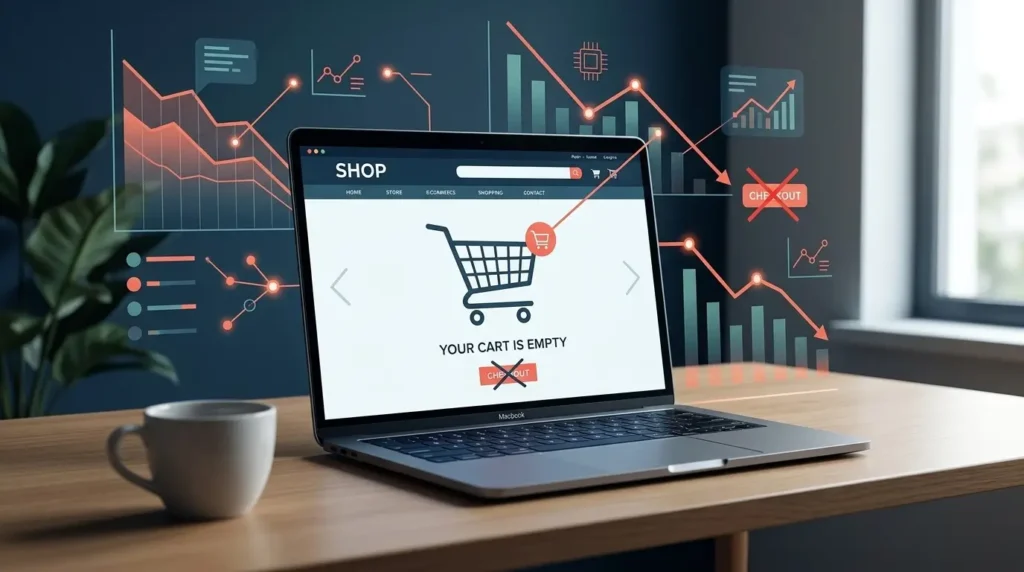
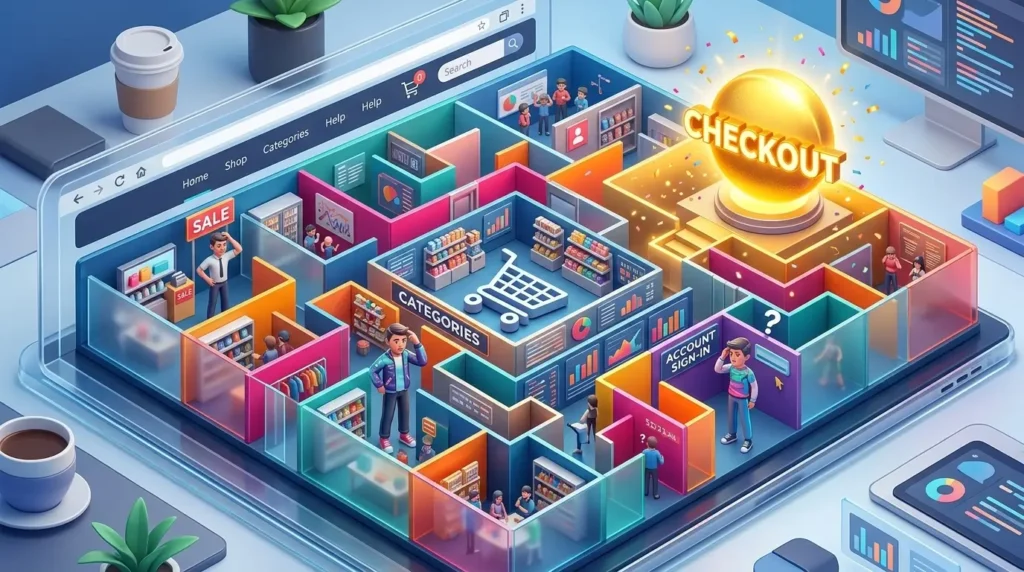
Mistake two: burying the checkout under friction. Forced account creation before purchase. Five form fields when two would do. No guest checkout option. Every extra step costs you a percentage of buyers, and small businesses feel that percentage far harder than a big retailer does you don’t have the volume to absorb the drop-off.
Mistake three: no local signals anywhere on the site.
This is the one nobody talks about. If you’re a small UK business with any kind of physical presence even just where you pack orders from your homepage, product pages, and footer should say so. “Handmade in Farnham, shipped across the UK” does more trust-building work than a paragraph of brand copy. It also happens to be exactly the kind of language that helps you show up in local search results, which matters enormously if part of your customer base is local pickup or delivery.
Mistake four: treating design and SEO as separate projects.
This is probably the costliest mistake of all. A site gets designed first, then someone’s brought in afterward to “do the SEO,” and by then the site structure, URL patterns, and page speed are already baked in wrong. Product page URLs stuffed with random ID numbers instead of readable text. No schema markup for products or reviews. Images uploaded as 4MB files straight from a camera, tanking load speed. Fixing this after launch costs more than building it right the first time.
What It Actually Costs and What It Actually Looks Like
Let’s be specific, because vague pricing helps nobody.
| Store type | Typical UK cost | What you’re actually getting |
|---|---|---|
| Template-based (Shopify/WooCommerce, DIY-adjacent) | £800–£2,000 | Pre-built theme, light customisation, basic product setup |
| Custom-designed small business store | £2,500–£6,000 | Bespoke design, proper UX planning, mobile-first build, basic local SEO foundation |
| Full custom build with ongoing support | £6,000–£15,000+ | Fully bespoke design and functionality, integrations (stock, delivery, POS), structured local + product SEO baked in |
Ongoing costs matter too, and this is where small businesses get caught out hosting, plugin updates, security patches, and basic maintenance typically run £50–£200 a month depending on store complexity, and skipping this is how sites quietly break six months after launch with nobody noticing until sales drop.
A realistic build timeline for a proper small business store, done right rather than rushed, sits somewhere between four and eight weeks anything promising a full custom store in five days is either a template with your logo slapped on it, or corners are being cut somewhere you won’t see until later.
What to Actually Look For Before You Commission a Store
Run through this before signing anything:
- Ask to see their mobile checkout, live, on their phone, in the meeting. If they hesitate or pull up a desktop version instead, that tells you something.
- Ask how page speed is handled — specifically image compression and hosting. “It’ll be fast” isn’t an answer; a target load time under 3 seconds is.
- Ask whether local SEO is included or a separate cost. If your customer base includes anyone local, this shouldn’t be bolted on afterward — it should shape the site structure from day one.
- Check if you own the platform outright. You should be able to leave and take your store, product data, and customer list with you, no exceptions.
- Ask for one example of a small UK business they’ve built for, not an enterprise brand the challenges are genuinely different.
- Confirm what happens post-launch. Who fixes it if the checkout breaks on a Saturday when you’re relying on weekend sales?
Back to the Candle Maker
Six weeks after we rebuilt her store mobile-first, two-step checkout, her Farnham location and delivery radius front and centre on the homepage, proper local SEO structure baked into the product pages her order volume didn’t just improve, it changed shape. She started getting local pickup requests she’d never had before, people who’d found her through “gift shop near me” searches and realised they could just walk in. The product range never changed. The photography barely changed. What changed was whether the site actually worked for the person trying to buy from it.
A small business website doesn’t need to look impressive. It needs to sell, and it needs to say clearly who you are and where you are, because for a UK small business, that’s very often the whole reason someone chooses you over a faceless alternative.
If you’re weighing up a new store or wondering why an existing one isn’t converting, the team at Epic Marketo can take an honest look at what’s actually holding it back and if local visibility is part of the gap, their local SEO service is worth folding into the same conversation rather than treating as an afterthought.